
Legal Realignment at the Supreme Court
March, 2026
Harvard Law Professor Richard M. Re has a really interesting thesis about the Supreme Court. His claim is that legal ideologies are not permanently connected to the principles of "constraint" (formalism, textualism, strict rules) or "discretion" (flexibility, purposivism, judicial empowerment). The side in power favors judicial discretion because it gives them the flexibility to implement the partisan agenda they favor. The side out of power favors judicial constraint because it limits the power of the majority. His papers Legal Realignment (2024) and Foreword: To A Conservative Warren Court (2025) explore this idea in depth and analyze it in the context of today's Supreme Court.
As an untrained, casual observer of the Supreme Court, I was always confused by the legal philosophies supposedly underlying Supreme Court decisions. It just seemed that principled adherence to those philosophies should result in more opinions that go against the partisan leanings of the justices.
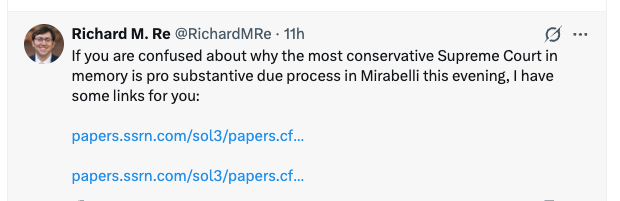
Update 2026-03-02: The Supreme Court vacated a U.S. Appeals Court stay (9th Circuit) in Mirabelli v. Bonta. This ruling reinstates a federal district court ruling that prohibits California schools from concealing a child's gender presentation from their parents and requires the schools to follow parental instruction regarding the names and pronouns that their children use.
This ruling is consistent with Re's thesis of legal realignment in that conservatives are basing the ruling in part on "substantve due process", specifically in Barrett's concurrence (joined by Roberts and Kavanaugh). The conservatives usually argue that judges shouldn't find "unexpressed rights" in the Constitution (the basis for overturning Roe. v. Wade). In this case, they were OK with protecting the unexpressed rights of parents.
This Advisory Opinions podcast features an interview with Richard Re about his Conservative Warren Court essay. Re's latest paper analogizes today's Supreme Court with the Warren Court, in that they both had a durable ideologically aligned majority acting as a "corrective force" to reshape American society and overturn long-standing precedents.